

A closer look at Constructive Bio’s approach
Constructive Bio is proudly synthetic biology. The discipline has its own engineering paradigm baked into how it works: Design-Build-Test. You design a genetic construct, you build it, and then test whether it does what you wanted. Iterate and repeat.
Design-Build-Test is how synthetic biology gets done inside the lab. But it is not how you take breakthrough science out of the lab and into the world.
That’s where Design-Make-Cure comes in. It’s our version of that same engineering logic, extended past the lab. The loop doesn’t end at a successful experiment, it ends with a solution for patients. Here is what each word means to us.

Design
Billions of years ago, before the last common ancestor of all living things, nature settled on a design and it stuck. Twenty amino acids, specified by 64 three-letter ‘codons’ in the genetic code (61 that call for amino acids, with plenty of redundancy, plus three that say ‘stop’). With only a handful of exceptions and tweaks, that is the palette nearly every organism on Earth has used to build its proteins.
It’s a remarkably capable system, with incredible diversity that’s visible all around us. But it’s also a constrained one.
Instead of designing to nature’s selection, we think there’s a huge opportunity to design a diverse array of possibilities. That means re-engineering a cell’s own protein-production machinery to expand the genetic code so that it recognizes amino acids outside of nature’s standard set.
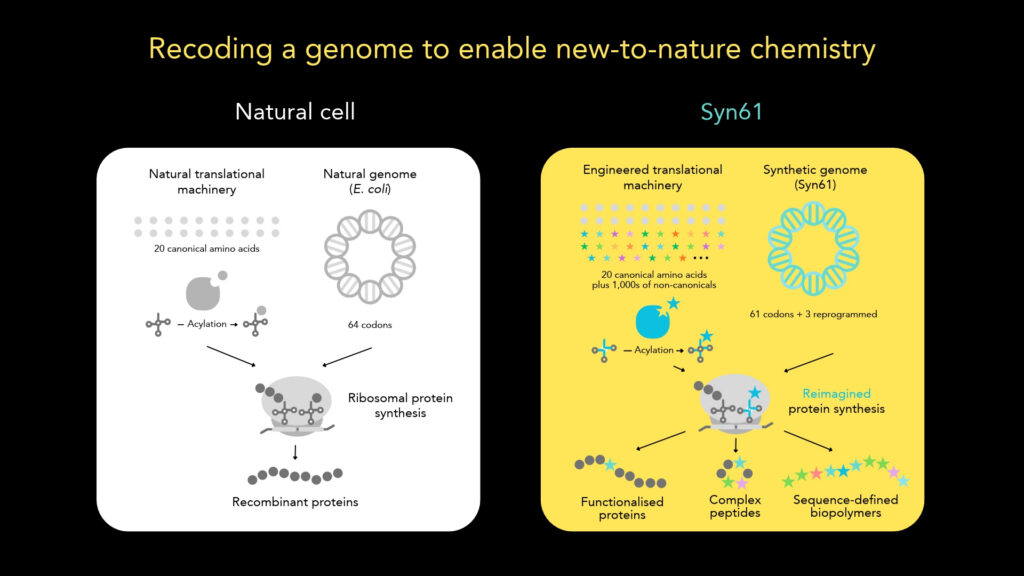
Nature’s 64 three-letter codons specify just 20 amino acids and a stop signal. Constructive Bio’s platform is built to expand that palette.
There are three ways to incorporate such non-canonical amino acids (ncAAs), which are amino acids beyond the standard twenty. One way is to hijack a stop codon and compete with the cell’s existing machinery. A second is to re-engineer the machinery to read an entirely new type of code. The third and most clever approach is to compress the existing code, effectively creating a first partition dedicated to making the proteins that the cell needs to survive, and a separate partition dedicated entirely to new amino acids. That last approach is the one our platform is built on, and it is what Jason Chin, our co-founder and CSO, spent the better part of two decades making work.
“Our vision is to turn cells into programmable factories, able to build molecules that chemistry alone could never make,” says Chin.
That vision begins with Syn61. It’s the first fully synthetic recoded genome, built in E. coli, the workhorse organism of synthetic biology. With over 18,000 individual codon substitutions built into its genome, Syn61 runs on a genetic code unlike anything else in nature, freeing up codons to encode amino acids that were previously off-limits. That freedom makes everything downstream possible.
Make
Ozempic and Wegovy are two of the most commercially successful drugs of the decade, and part of the reason they work as well as they do is that they take advantage of the broader non-canonical design space described above. Their ncAA chemistry shields those peptide drugs from degradation in the bloodstream, which is key to extending their action from hours to a week. That’s a genuine achievement. It also comes with a cost.
Solid-phase peptide synthesis (SPPS), the standard chemical method for building a peptide, works well for short chains with standard chemistry. Introduce ncAAs, particularly those with strained or sensitive functional groups, and the process becomes more demanding. Protecting group strategies multiply, coupling efficiency drops, and purification complexity grows with every additional step. Chain length compounds every one of these challenges. The result is that the molecules with the most interesting non-canonical chemistry are often the hardest and most expensive to manufacture reliably at scale.
There is also a real sustainability cost to making peptide drugs with conventional SPPS chemistry. Producing one kilogram of peptide by solid-phase synthesis generates an estimated 13,000 kilograms of waste, roughly the weight of a full city bus, more than half of it organic solvent. The chemistry that makes these drugs work is also the chemistry that makes them expensive and environmentally costly to produce at scale.
Biology doesn’t face those same limits, and our BioForge platform is built to take advantage of that. It uses the cell’s own translation machinery to encode multiple chemically complex ncAAs directly, producing peptides and proteins that chemistry cannot reliably deliver, cleanly and at manufacturing scale.
Daniel de la Torre, our VP of R&D, puts it this way: “We’re bridging the gap between what chemistry can do and what biology can do, so we can make cleanly and at scale what used to be painful or impossible in the chemistry lab.”
In practice, Design and Make are inseparable. The machinery that reads an expanded genetic code is the same machinery doing the manufacturing. By solving the design problem, we also opened a path to manufacturing at scale, unlocking a vast new class of molecules that neither chemistry nor conventional biology could reach alone.
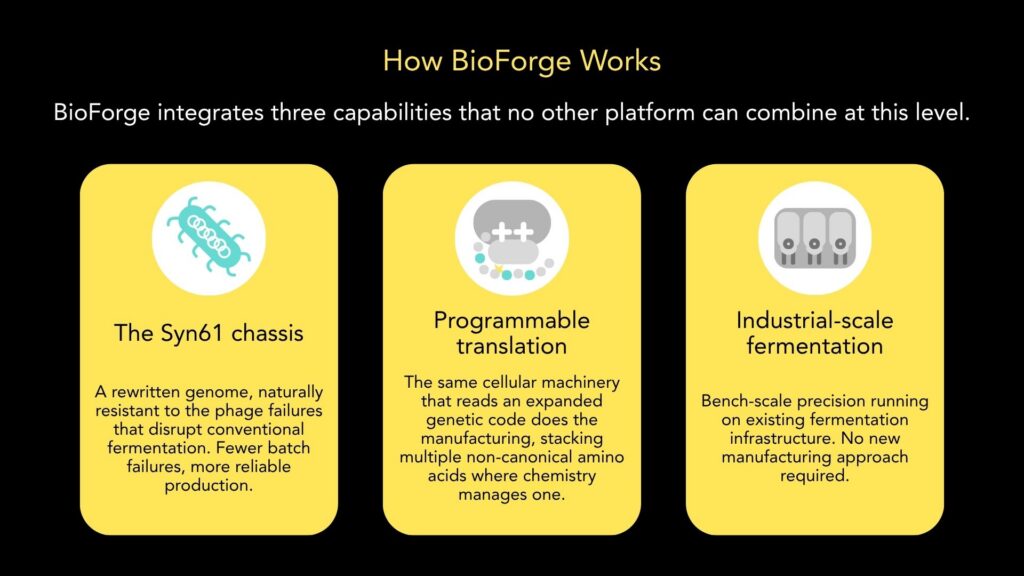
BioForge combines a rewritten genome, programmable translation and industrial-scale fermentation.
Cure
Most of the medicines our industry makes manage a disease instead of ending it.
A single non-canonical amino acid, precisely placed, can change how a drug behaves in the body. Add a methyl group to alanine and you get a property that helps give drugs like Ozempic and Wegovy their resistance to degradation and their extended half-life in the bloodstream. Add a cyclopropene group to lysine and you get a chemical handle for precise, site-specific bioconjugation, the kind of chemistry antibody-drug conjugates use to attach a payload exactly where it needs to go.
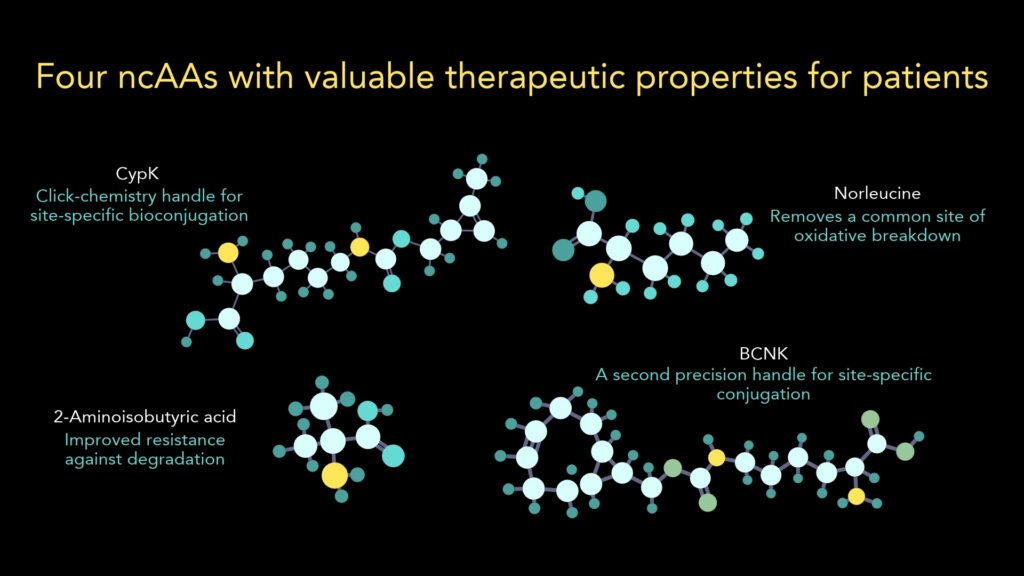
Non-canonical amino acids (ncAAs) enabling new-to-nature chemistry.
Each of these advances is real, but each works within the logic of managing a disease. Stacking several ncAAs into a single molecule is what makes new logics emerge, opening up uncharted paths for addressing disease.
That is why we chose the word Cure, and we know it’s a big one to live up to. Most of what gets built through Design and Make will be therapies that manage a disease rather than cure it, and that’s not a failure. It’s roughly where the pharmaceutical industry’s chemistry has been for the past fifty years. Cure isn’t a claim about every program in our pipeline today. It’s a claim about where expanded chemistry can take us.
“What excites me is that expanding the genetic code gives us access to chemistry precise enough to aim at an actual cure, or further out, at preventing a disease before it starts,” says Ola Wlodek, Constructive Bio CEO.
Out of the Lab, Into the World
Synthetic biology has always aspired to more than lab-bench proofs of concept. The field’s founding ambition was to make biology into an engineering discipline, something you could design against, build reliably, and deploy at scale, the way you would with any other engineered system.
Re-engineering the genetic code of E. coli to design and make useful therapeutics at scale is how we’re realizing that aspiration. But with a meaningful difference: Syn61 and BioForge have graduated from a proof of concept in a synthetic biology lab. They represent a genome that can write new chemistry, a production process that scales, and a platform for bringing better medicines to patients.
“Design” gives us access to a vast new set of building blocks. “Make” gives us a way to produce the proteins at scale. “Cure” is the reason this is all worth doing.
“None of this matters if it doesn’t reach the people who need it,” Ola says. “Every genome we recode, every molecule we design, is in service of getting something real into a patient’s hands.”