

Design
A New Language For Biology.
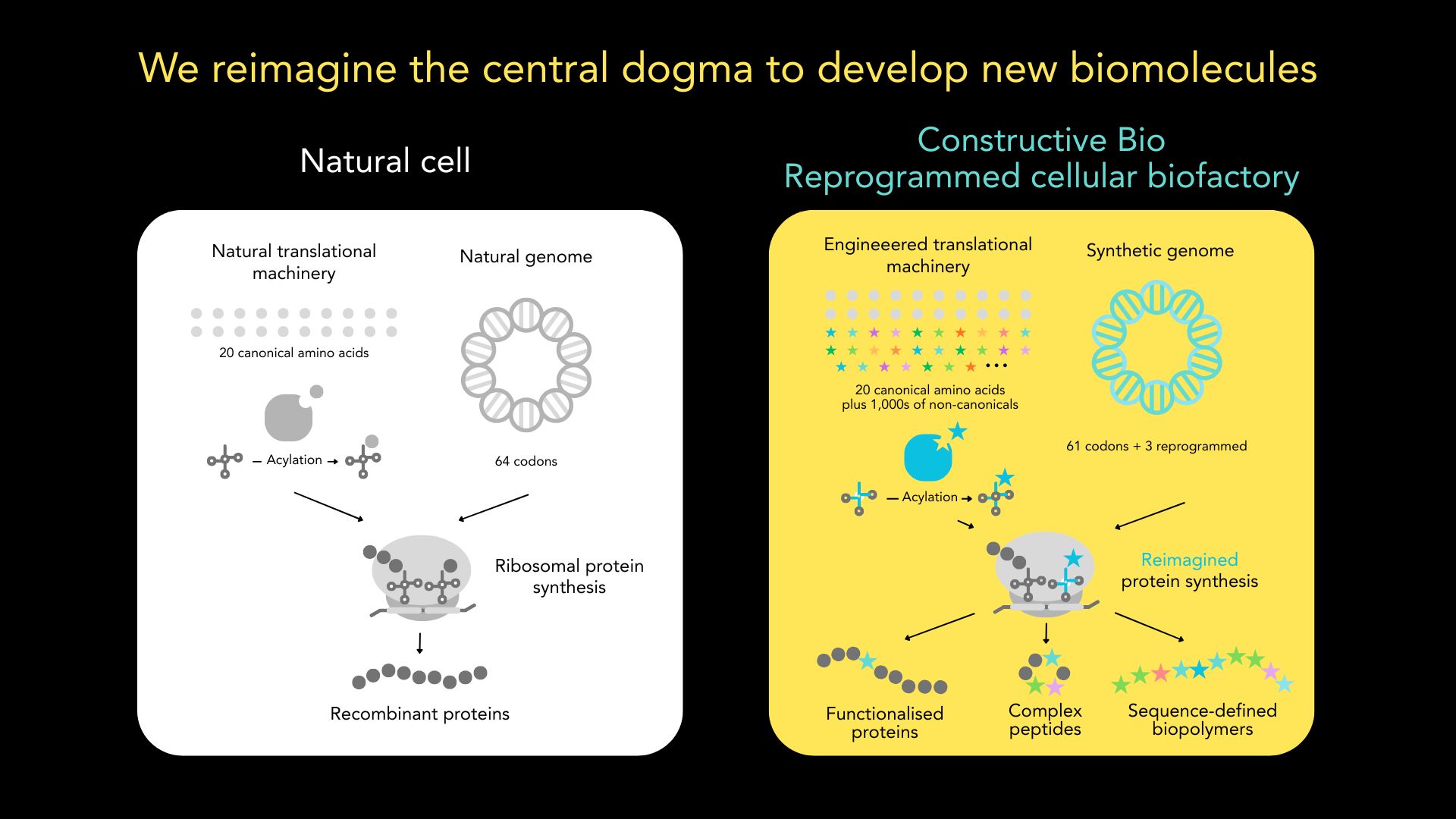
We use Syn61 — the world’s first organism with a fully recoded genome — and engineered translational machinery to enable cells to incorporate entirely new chemical building blocks into proteins. We go beyond creating variations of what nature already does to design genuinely new chemistry from the ground up.
We now have access to a vast chemical design space that natural biology could never reach, and AI-driven protein design tools cannot imagine.
The science behind the (design) space.
Syn61: A recoded organism.
The genetic code contains 64 codons, but many are redundant and encode the same amino acid. In Syn61, the Chin Lab systematically removed that redundancy, rewriting thousands of DNA sequences to produce an E. coli that operates on just 61 codons.
This creates three free codons — slots in the genetic code that can now be reassigned. Using engineered transfer RNAs (tRNAs) and their partner synthetase enzymes, those slots can be loaded with non-canonical amino acids (ncAAs): chemical building blocks that don’t exist in natural biology.
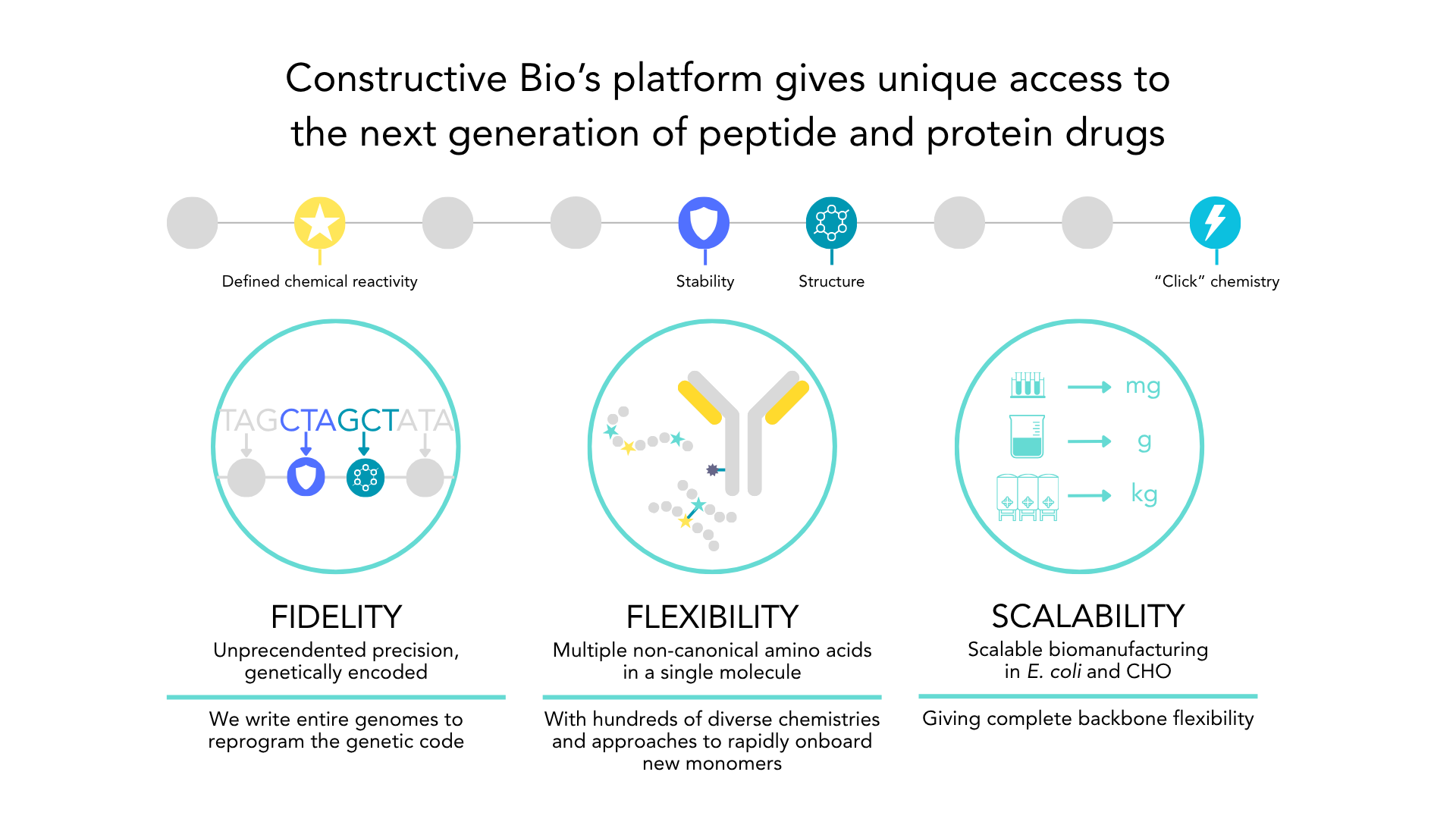
The result is unique: Syn61 incorporates ncAAs with complete fidelity, and can incorporate multiple distinct ncAAs within the same protein. This combination of fidelity and multiplicity is what distinguishes Syn61 from other genetic code expansion platforms.
Syn61 is also inherently phage-resistant. Because its genetic code has been altered, most viruses that infect standard E. coli cannot replicate inside it — a practical advantage for industrial fermentation.
Engineered translational machinery.
Proteins are assembled inside cells by ribosomes, which read codons and recruit transfer RNAs carrying the corresponding amino acids. To install new chemistry into proteins, this machinery must be reprogrammed.
Constructive engineers tRNA-synthetase pairs that recognize the reassigned codons in Syn61 and deliver non-canonical amino acids to the ribosome at defined positions in a protein sequence. Crucially, the platform supports multiple ncAAs within a single molecule — not just one new building block, but several, precisely placed.
We can incorporate a wide diversity of chemistries from our expansive existing library, and we can readily onboard new chemistries on demand. We go far beyond single amino acid substitutions to enable multiple new chemistries into a single protein architecture.
What expanded chemistry enables.
New building blocks introduce properties that natural proteins cannot possess and that standard chemical synthesis cannot efficiently produce.
We go beyond incremental design improvements to enable molecular architectures that were previously impossible to design and manufacture together in a single platform.
Site-specific conjugation handles
Reactive groups positioned exactly where a molecule needs them, enabling precise attachment of payloads, labels, or linkers.
Covalent binding chemistry
Reactive warheads installed within proteins for irreversible, highly selective target engagement.
Enhanced stability
Protease-resistant modifications that extend half-life and improve durability in biological environments.
Novel catalytic and binding functions
Chemistry that expands what a protein can do, not just what it looks like.
Expanding the capabilities of peptides and proteins
Three categories of non-canonical amino acids delivering transformative capabilities

Transformers
Enabling new functions
Unlock new functions that would be impossible with canonical amino acid chemistry alone.
- Novel reactivity
- Covalent biologics
- Non-native tertiary structures

Enhancers
Enhancing control
Deliver control where traditional chemistry falls short.
- Site-specific conjugation
- Protease resistance
- Targeted post-translational modifications (PTMs)

Modulators
Tuning performance
Modulate function with precision and nuance.
- Hydrophobicity
- Solubility
- Stability
From design space to design reality.
Advances in AI and computational protein design are accelerating what scientists can imagine. But imagination is moving faster than manufacturing. Many of the most exciting molecules emerging from AI-driven design pipelines remain stuck at the concept stage — possible in theory, impossible in practice.
Constructive changes that equation. The Design pillar establishes what chemistry is available. Make turns it into manufactured reality.
REFERENCES
Total synthesis of E. coli with a recoded genome
Nature 569, 514–518 (2019)
Describes the creation of Syn61 — the first organism with a fully synthetic, recoded genome — in which 18,214 codons were replaced to compress the genetic code from 64 to 61 codons, freeing three for reassignment to new chemical building blocks.
Sense codon reassignment enables viral resistance and encoded polymer synthesis
Science 372, 1057–1062 (2021)
Shows how removing the tRNAs decoding Syn61’s freed codons creates complete resistance to a broad range of bacteriophages and enables the incorporation of three distinct non-canonical amino acids into a single protein.
E. coli with a 57-codon genetic code
Science 390, eady4368 (2025)
Reports the creation of Syn57, the most radically recoded organism to date, in which seven codons have been freed across more than 101,000 genome changes, expanding the chemical space available for programmable protein design.
Reprogramming the genetic code
Nature Reviews Genetics 22, 169–184 (2021)
A comprehensive review by de la Torre and Chin of advances in genetic code expansion, covering recoded genomes, orthogonal translation systems, and the path toward genetically encoded synthesis of non-canonical biopolymers for therapeutic and materials applications.