

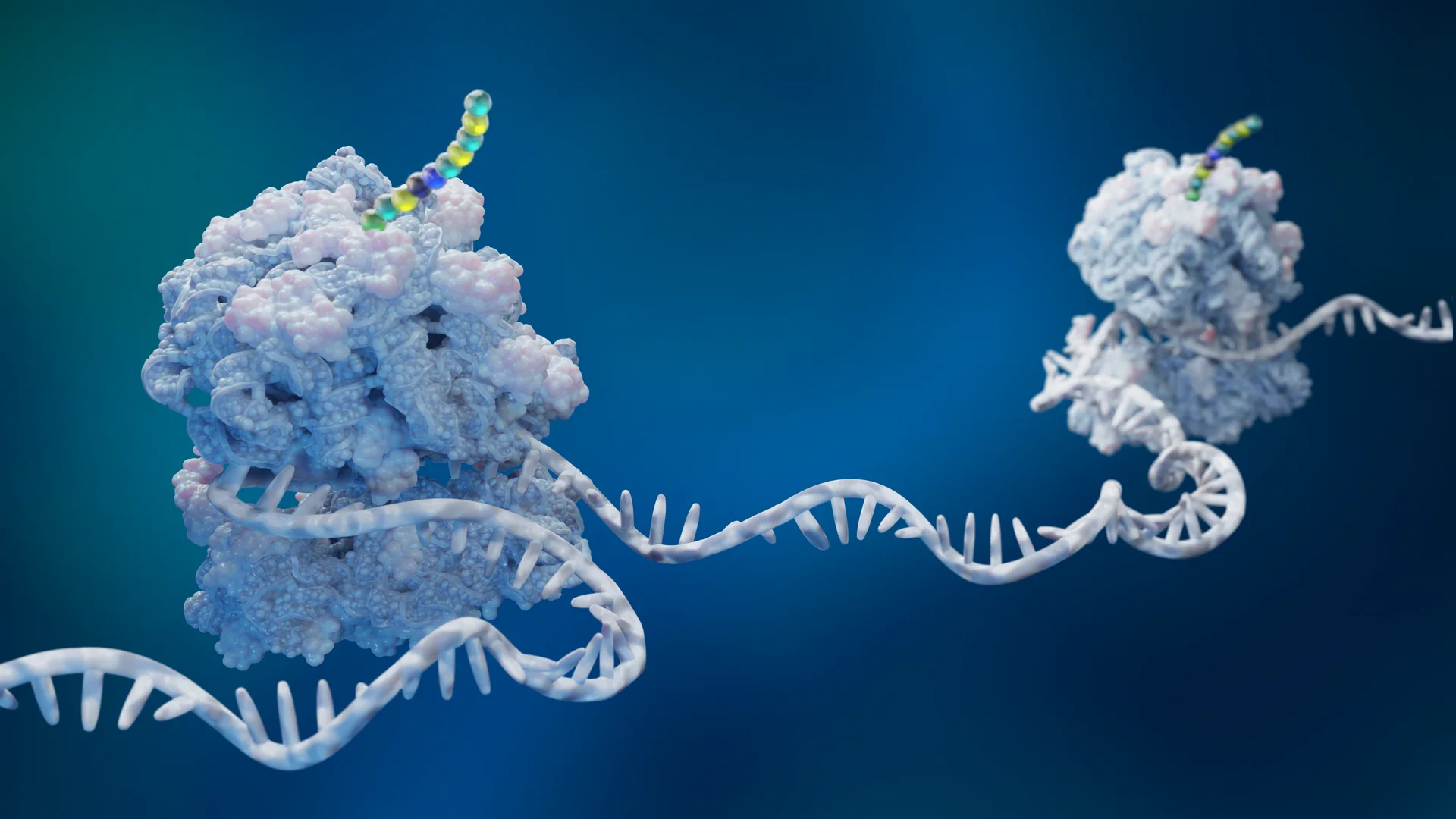

Engineering the future of biology with revolutionary genome synthesis and expanded genetic code technology.
Stability, binding
-
ncAA
Aib/αMeL -
Incorporation molecule
GIP-like peptide -
Impact
Stability, binding
Description
In December 2025, Eli Lilly shared topline Phase 3 results from TRIUMPH-4 for retatrutide, a first-in-class triple agonist of GLP-1, GIP, and glucagon receptors. Over 68 weeks, people with obesity or overweight plus knee osteoarthritis lost up to 71.2 lb (≈28.7% of body weight), with meaningful drops in osteoarthritis pain and better physical function.
Retatrutide is a 39-mer peptide built mainly on a GIP-like scaffold, tuned to engage all three receptors. A C20 fatty diacid is attached to Lys17 (via a linker) to extend half-life. In the core sequence, Lilly inserted: Aib (α-aminoisobutyric acid) at positions 2 and 20 lock in helical geometry and confer resistance to DPP-4 proteases; αMeL (α-methyl-L-leucine; "α-methylleucine") at position 13 strengthens hydrophobic contacts. These modifications transform a simple peptide into a life-changing drug.
Citation: Lilly release, 2025
Retatrutide, Eli Lilly's first-in-class GLP-1/GIP/glucagon triple agonist, demonstrates what non-canonical amino acids can achieve at clinical scale. In Phase 3 trials, patients lost up to 28.7% body weight over 68 weeks, with improvements in osteoarthritis pain and physical function.
Two ncAAs are central to the drug's performance. Aib (alpha-aminoisobutyric acid) at positions 2 and 20 locks the peptide into helical geometry and confers resistance to DPP-4 proteases, the enzymes that rapidly degrade natural GLP-1 in the body. Alpha-methyl-L-leucine at position 13 strengthens hydrophobic contacts with receptor binding surfaces. Together with a C20 fatty diacid for albumin binding, these modifications transform a 39-residue peptide from a rapidly cleared signalling molecule into a once-weekly therapeutic (Eli Lilly, 2025).
Retatrutide illustrates the commercial reality: ncAAs are already in blockbuster drugs. The question for peptide developers is not whether ncAAs add value, but how many can be incorporated and at what manufacturing scale.