24 recent non-canonical amino acid breakthroughs
A roundup of 24 non-canonical amino acid advances published in 2025, spanning oncology, drug delivery, enzyme engineering, antimicrobials, gene therapy, and materials science.
Key takeaways
Non-canonical amino acid advances highlighted, each with a published research example from 2025
Improvement in tumour-directed gene delivery using AzK-modified AAV capsids
Enantiomeric excess achieved by a designer enzyme containing a biosynthesised ncAA
Serum stability of fluorinated antimicrobial peptides, up from 225 minutes for unmodified versions
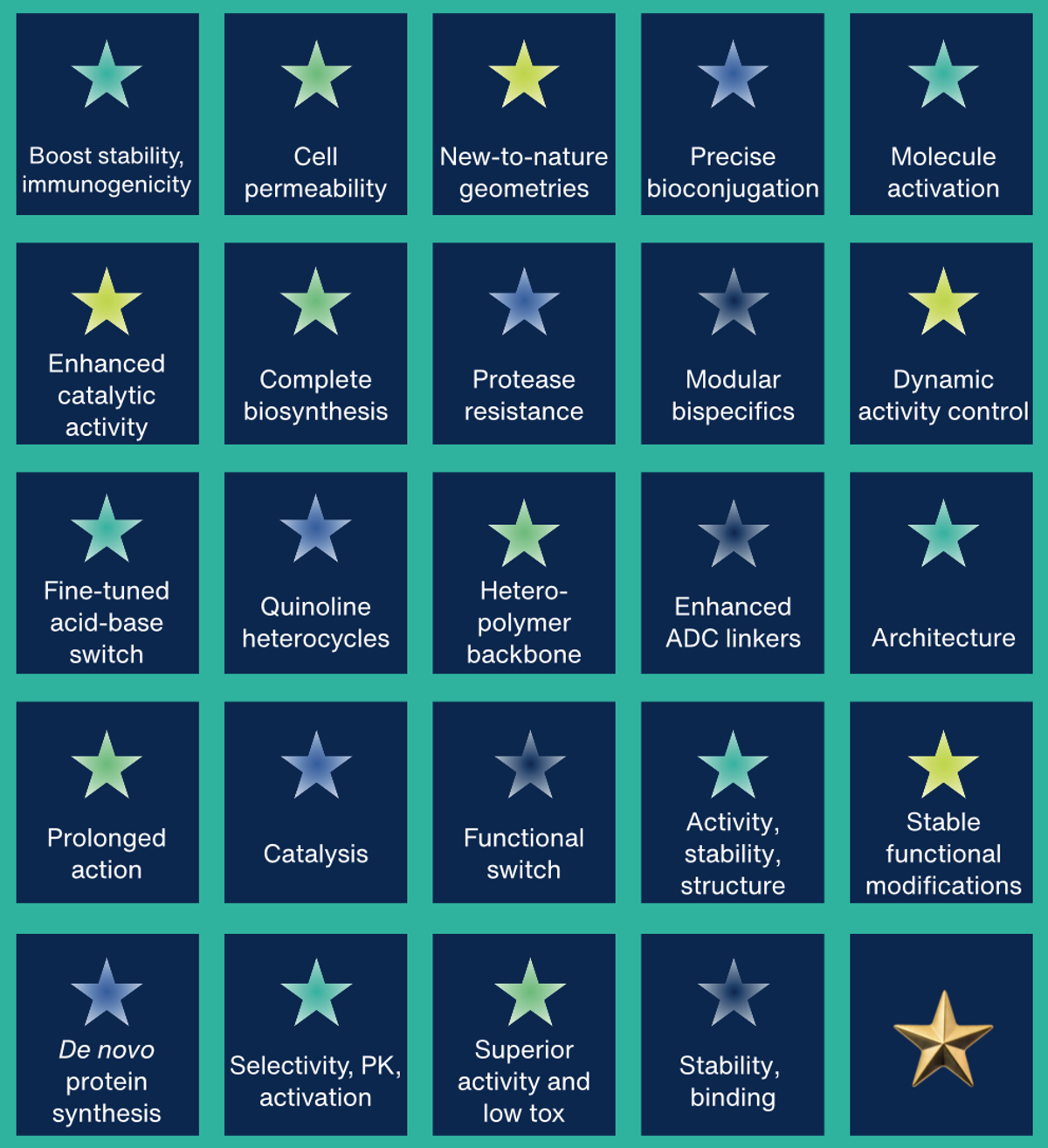
Non-canonical amino acids are no longer a niche research curiosity. In 2025, ncAA-based approaches appeared across oncology, gene therapy, antimicrobial development, enzyme design, and materials science in leading journals. This roundup collects 24 of the most notable advances, drawn from Constructive Bio's December 2025 ncAA Advent Calendar series.
Why ncAAs are accelerating across biotech
The pace of ncAA research has increased sharply. What was once limited to proof-of-concept studies in a handful of laboratories now spans clinical-stage drug programmes, industrial enzyme platforms, and entirely new classes of biomaterial. The examples below illustrate the breadth of the field in a single year.
Therapeutics and drug delivery
Cancer vaccines: beta-amino acids incorporated into MUC1-based glycopeptides improve proteolytic stability and immunogenicity while maintaining native epitope conformation. This addresses a core challenge in peptide vaccine design, where natural sequences are degraded before they can stimulate an immune response.
Targeted cancer therapy: BH3 mimetics containing ncAAs achieve fourfold improvements in binding affinity for MCL-1 and BCL-xL targets in acute myeloid leukaemia. Rigid cyclohexyl side chains provide shape complementarity that standard amino acids cannot access.
Cell-penetrating biologics: beta-lactam-lysine enables domain antibodies to cross cell membranes by forming intramolecular covalent straps, achieving spontaneous uptake at 40 nM with clean endosomal escape. This opens intracellular targets to antibody-based drugs.
Gene therapy targeting: azide-containing ncAAs (AzK) placed in AAV capsid proteins allow site-specific conjugation of targeting ligands, improving tumour-directed gene delivery 19-fold in vivo. This is a significant step toward tissue-selective gene therapy vectors.
Multi-receptor agonists: retatrutide, a triple GLP-1/GIP/glucagon receptor agonist, uses Aib and alpha-methylleucine to achieve the metabolic stability required for once-weekly dosing. These ncAA modifications are essential to the molecule's pharmacokinetic profile.
Covalent binders: SuFEx-reactive amino acids (fluorosulfate-L-tyrosine) form selective covalent linkages with target proteins, enabling prolonged drug activity without the off-target risks of conventional covalent inhibitors.
Protein engineering and catalysis
Bispecific nanobodies: pAcF (p-acetylphenylalanine) enables controlled geometry in bispecific nanobodies for colon cancer immunotherapy, improving tumour-penetrating immune activation through precise linker positioning.
De novo enzyme design: E. coli engineered to both produce and incorporate pAPhC achieves complete biosynthesis of a designer enzyme that performs enantioselective Friedel-Crafts alkylation with 95% enantiomeric excess. No external ncAA supply is needed.
Gold catalysis in a protein scaffold: a noble-metal-binding ncAA (pSHF) installed in LmrR protein creates a hybrid gold catalyst for pi-activation chemistry within a biological scaffold.
Photoswitchable enzymes: azobenzene and spiropyran-based ncAAs allow light-controlled enzyme activation, with potential applications in spatially and temporally controlled biocatalysis.
Laccase optimisation: hydrophobic ncAAs improve catalytic activity by fine-tuning the active site environment, demonstrating that even subtle side-chain changes can have large effects on enzyme performance.
Antimicrobials and stability
Fluorinated antimicrobial peptides: fluorinated ncAAs in WK2 peptides boost serum stability from 225 to over 1,440 minutes while maintaining activity against multi-drug resistant bacteria. This addresses one of the main barriers to clinical use of antimicrobial peptides.
Machine learning-guided design: alpha/beta-peptide hybrids derived from aurein 1.2 achieve up to 52-fold higher antifungal selectivity, with candidates identified by screening 336,000 virtual candidates computationally before synthesis.
Materials and biomolecule design
Post-translational modification mimics: 11 distinct lysine PTM analogues generated from a single MeOK precursor, enabling systematic study of how modifications affect protein function.
Backbone editing: the BEAR approach uses reactive ester ncAAs to modify the peptide backbone after ribosomal synthesis, creating structural diversity that cannot be programmed genetically.
Tunable acid-base switching: histidine-like ncAAs with adjustable pKa values enable pH-responsive protein behaviour for drug delivery and biosensor applications.
Ribosomal pharmacophore embedding: keto-ncAAs enable intramolecular Friedlander cyclisation to embed quinoline pharmacophores directly into ribosomal peptides, merging medicinal chemistry with biological synthesis.
Collagen engineering: L-DOPA incorporation into collagen enhances self-assembly and biocompatibility, relevant to tissue engineering and medical device coatings.
What these advances mean for the field
These examples span clinical-stage drugs, computational enzyme design, and novel biomaterials. ncAA technology is now producing real results across multiple fields simultaneously. For a deeper introduction to ncAAs and how they are incorporated, see our overview of non-canonical amino acids and programmable biomolecules.
Related peer-reviewed research
Engineered triply orthogonal pyrrolysyl–tRNA synthetase/tRNA pairs enable the genetic encoding of three distinct non-canonical amino acids
Dunkelmann, D.L., Willis et al. — Nature Chemistry 12(6), 535–544 (2020)
Five Mutually Orthogonal tRNA Systems Enable Up to Five Distinct Non-Canonical Amino Acids in a Single Protein
Beattie, A.T., Dunkelmann et al. — Nature Chemistry 15, 948 (2023)
Phage Display with Multiple Non-Canonical Amino Acids Enables ncAA-Containing Peptide Library Screening for Drug Discovery
Oller-Salvia, B., Chin et al. — Angewandte Chemie International Edition 58, 10844 (2019)
Non-Standard Backbone Chemistries Added to the Genetic Code of a Living Organism for Enhanced Peptide Therapeutics
Dunkelmann, D.L., Piedrafita et al. — Nature 625, 603 (2024)
Get the full white paper (PDF)
Free, with email registration
Download started!
Explore our platform
See how this research translates into next-generation peptide therapeutics.