

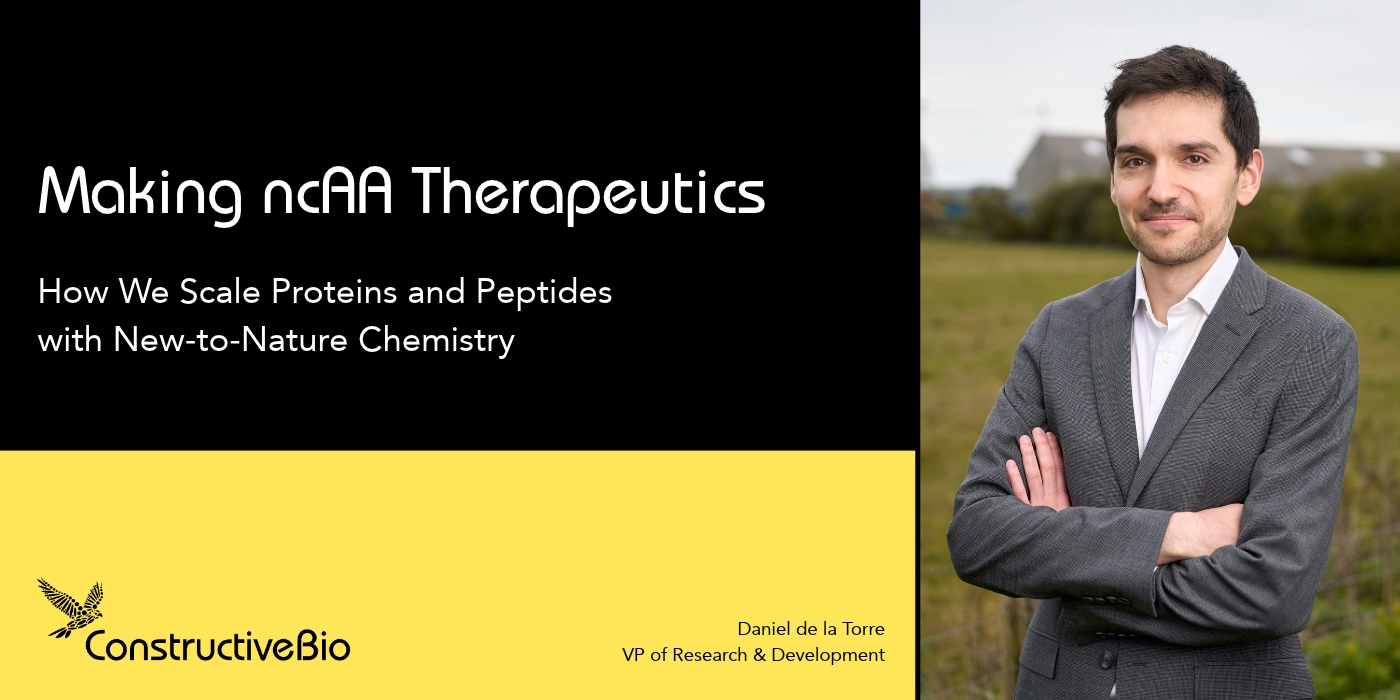
“The chemical universe is vast,” says Daniel. “What we offer is a way to navigate and explore the chemical sequence space uncharted by natural biology.”
Daniel spends most of his time thinking about reprogramming the genetic code of living cells: rewriting genomes, engineering key molecular machinery, and making biomolecules that nature has never seen. But as Constructive Bio brings the world’s first synthetic recoded organism and its BioForge manufacturing platform to drug makers, he’s often in conversation with pharma leaders about what is newly possible these days. And those conversations are as much about the technology as they are about grasping this new ability to create biomolecular matter that has so far been physically inaccessible.
Biology genetically encodes biomolecules in a way that is both scalable and programmable, but it has a limited chemical toolkit restricted to 20 amino acid building blocks. Synthetic chemistry offers far more technical freedom, but stringing amino acids together gets more difficult as the sequence gets longer, and scaling up can be tricky. As of now, combining the programmability of biology with the flexibility of synthetic chemistry had few industrial precedents. Daniel believes we’re at a turning point.
Beyond a handful of ncAAs
Ask which non-canonical amino acid a pharma partner wants, and Daniel says you’ll usually hear the same handful of names. That’s not because those are the only options that work, but because using an already-validated building block removes a variable from an already risky project.
“If someone used non-canonical amino acid X and found that it fulfills this function,” he explains, “and I want to do trait stacking, or add the next thing, I’m just going to leave that untouched.”
That’s a rational if conservative instinct, and it has produced some of the best medicines of the past decade. But it also means the field has explored only a narrow slice of a very large possibility space.
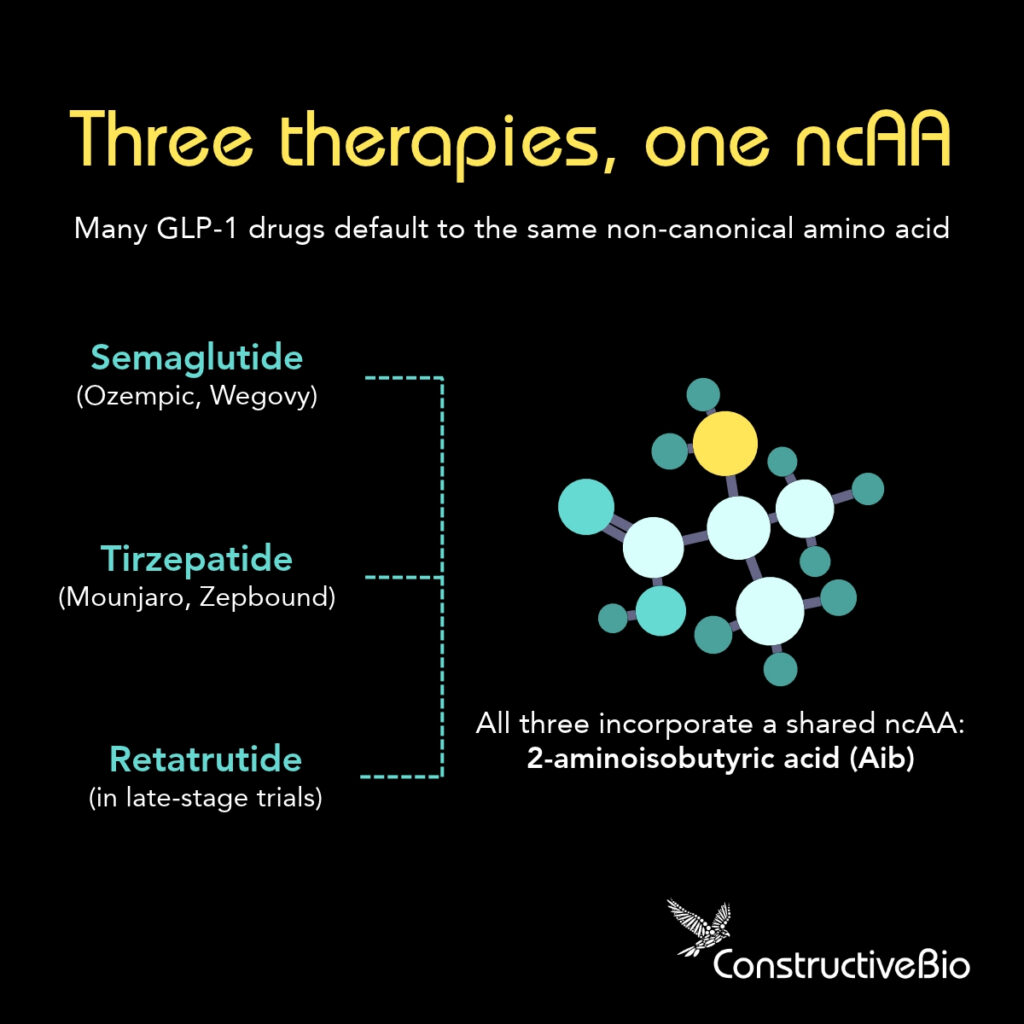
Weight loss medicines have moved from single-receptor to multi-receptor therapies, and the molecules keep getting more complex to build. Semaglutide targets GLP-1, tirzepatide adds GIP, and retatrutide adds glucagon. All three drugs share a non-canonical amino acid: 2-aminoisobutyric acid.
Repeatedly, what Daniel and the Constructive Bio team have found is that there is life beyond the usual non-canonical amino acids. “If you look at non-canonical amino acid X, but you also look at a whole library of other non-canonical amino acids, there are many other solutions,” Daniel says. “It doesn’t always have to be X.”
For a function where the field has converged on one default choice, his team has usually found several viable alternatives that BioForge can manufacture. That raises a question about what goes untested. When every new building block has meant a new biological or manufacturing question mark, reusing what’s already proven is the safe move, but it also means a large part of the design space has never been searched, and some of the best molecules may never get made.
De-risking ncAA incorporation
But pitching genuinely new molecular chemistry to a risk-averse industry takes more than enthusiasm. Constructive Bio has to show to drug developers the data that gives them confidence that BioForge can dependably scale new-to-nature chemistry farther and farther away from anything the industry has made before.
How much proof a partner needs depends on how far a molecule sits from precedent. For chemistry the field has already validated, the question is a straightforward one: can BioForge make the same molecule more reliably, more cleanly, or at lower cost than solid-phase peptide synthesis? A head-to-head comparison answers it, and it’s the first thing a partner will ask.
The more interesting questions begin where precedent ends — ideas that build on something pharma already believes in, or a molecule that works but could work better. Conjugate vaccines are one example Daniel points to. “The imagination gap that needs to be closed here is relatively small,” he says. “It’s a derivative of something that already existed, and we can probably make it better.”
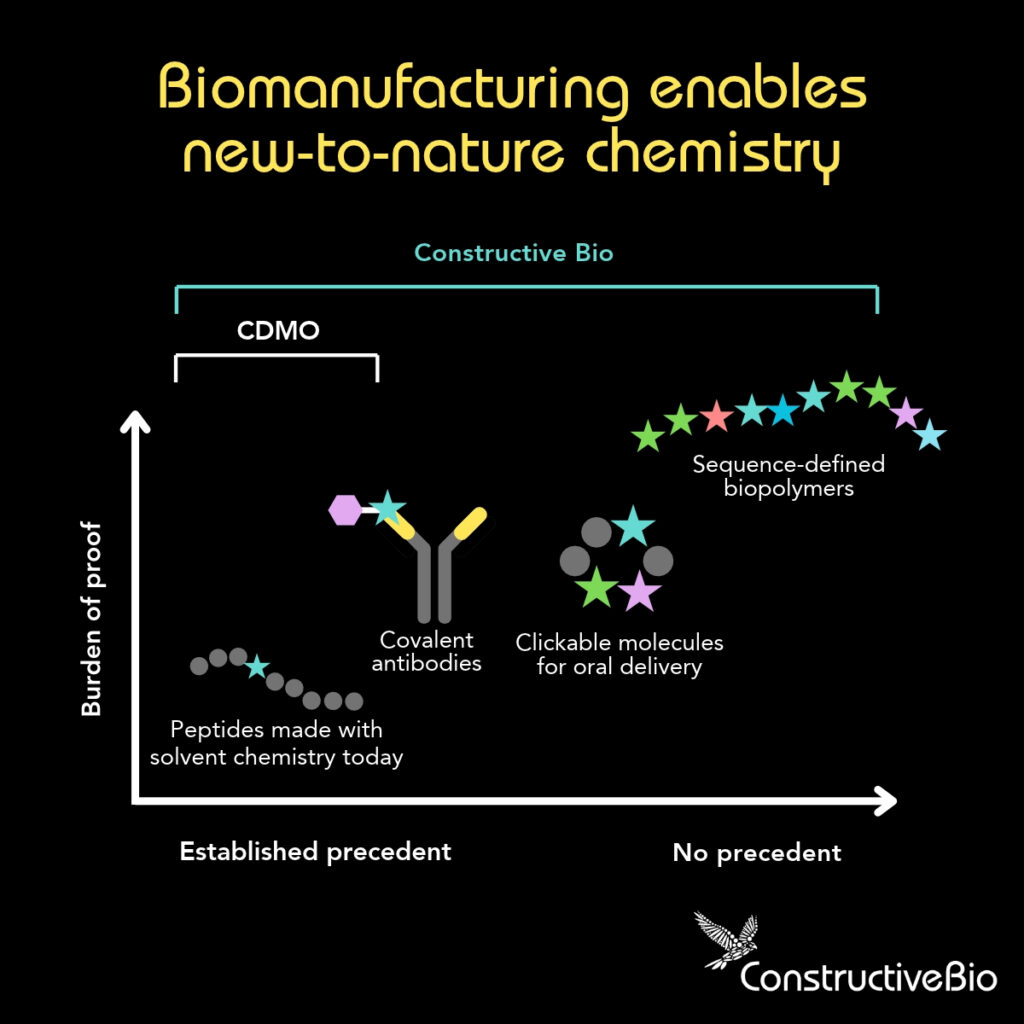
The amount of proof required to de-risk a molecule for manufacturing scales with its distance from precedent.
Further out still are truly new-to-nature molecules with no real precedent for scalable manufacturing, where Constructive Bio is building the case for manufacturability from scratch. ”Constructive has to show that we can make these molecules in the first place,” says Daniel, “and in the second place show they are useful.”
His clearest example in this “no precedent” category is a biologic engineered with a new covalent-binding property, explored at the research stage with promising biology but yet to be demonstrated in the clinic and in CMC. Researchers have long suspected this kind of functionality could be valuable, but testing it has been challenging since encoding it requires chemistry outside the twenty canonical amino acids. Constructive Bio’s job here is twofold: build the biologic with that property, then prove to a partner that the property is worth having.
CDMOs are never asked to show this kind of proof because their job is running a process someone else has already validated. Constructive’s job starts earlier: proving that a superior molecule is scalable before anyone commits to it.
Case in point: Oral bioavailability
Many of today’s most effective biologic drugs share an inconvenient limitation: they have to be injected. Taken as a pill, they’d be broken down in the stomach or fail to cross into the bloodstream before doing any good.
Daniel describes ncAA-enabled chemistry as one route toward solving this directly, through a proprietary class of molecules that combines non-canonical amino acids in ways designed to survive the gut and reach circulation intact.
It’s one early-stage example of what “new-to-nature chemistry” can mean for a patient in practice: a drug that doesn’t require a needle.
A robust synthetic strain
Syn61 is the manufacturing strain Constructive Bio uses to achieve scalability. Based on E. coli, Syn61 is the world’s first synthetic recoded organism, engineered by eliminating redundant codons from its genome so the freed codons could be reassigned to encode new-to-nature amino acids instead of duplicating ones the cell already had.
Biologists will ask: Is a completely recoded manufacturing strain robust enough for the job?
A genome recoded as extensively as Syn61 comes with question marks. Evolution spent billions of years optimizing E. coli‘s natural genome for performance. More than 18,000 edits to a wild type organism can carry a cost in cellular vigor.
“There’s a general skepticism around the robustness of these highly engineered systems,” Daniel admits, pointing to the gap between a heavily engineered strain and the industrial workhorse strains fermentation scientists already trust. The Constructive team has been closing that gap. Syn61 can now produce protein at levels comparable to industrial standards, while doing what no standard strain can: reliably incorporating multiple non-canonical amino acids into a single protein.
“The work isn’t complete,” Daniel says candidly, “but you can now make multi-gram per litre amounts of product containing multiple ncAAs using the strain.”
Betting on a bigger version of what’s possible
For Daniel, the concept of re-engineering biology is what drew him to become a scientist. But what drives him today is proving that it can make better molecules.
He puts it plainly: Better proteins and peptides built with ncAAs are no longer a hypothesis, and Constructive Bio is ready to show its partners how to make them with biology at scale.